What Is the Expansion?
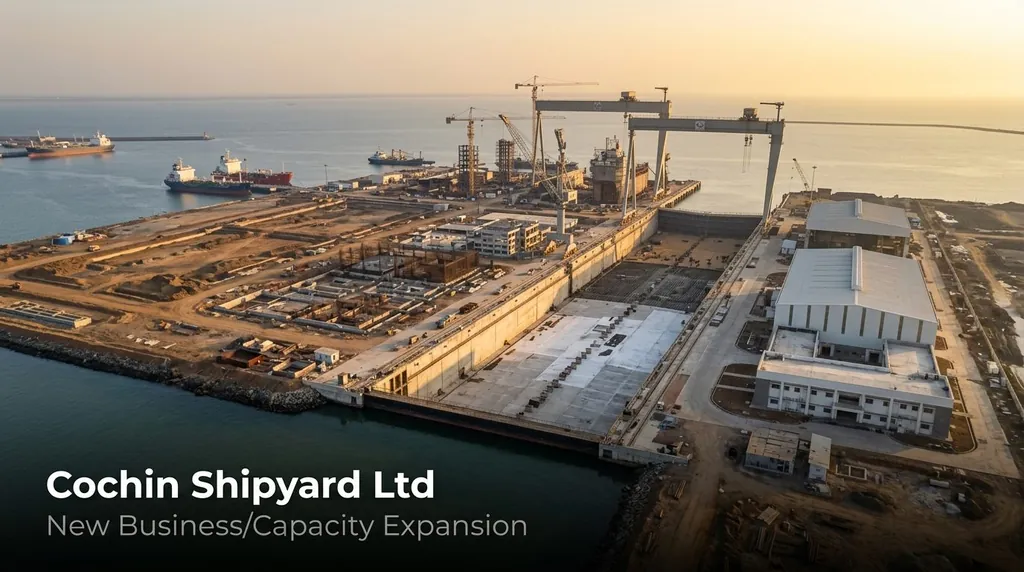
The development at Vadinar, Gujarat, is structured as a brownfield project designed to expand India's national ship repair ecosystem. While the Deendayal Port Authority will manage the civil infrastructure and a 650-meter jetty at an estimated cost of ₹650 crore, Cochin Shipyard is responsible for the specialized ship repair infrastructure. This includes the acquisition and installation of two large floating dry docks and dedicated workshops, representing a ₹920 crore capital commitment from the company.
The project is scheduled for completion within a 36-month window and marks a significant step for the shipyard in establishing a physical operational presence on India's western coastline.
Strategic Rationale
The Vadinar facility is strategically positioned to bridge a critical infrastructure gap in India's maritime sector. Currently, the country lacks adequate domestic capacity to repair vessels exceeding 230 meters in length. By enabling services for vessels up to 300 meters, the shipyard aims to capture high-value repair contracts that are often outsourced to foreign shipyards.
The location offers a natural deep draft and connectivity to major shipping routes near Mundra and Kandla. This proximity is expected to reduce turnaround times for large commercial and foreign-flagged vessels while stemming the outflow of foreign exchange through localized high-value services.
Business Context and Financials
Cochin Shipyard operates as a leading player in India's shipbuilding and repair industry, currently classified as an Expensive Performer with a market capitalization of ₹45,620.84 crore. The company reported annual operating revenue of ₹4,819.96 crore, reflecting a 25.8% year-on-year growth. While the quarterly net profit recently saw a 18.26% decline, the firm maintains a healthy momentum score of 52.26.
The new Vadinar unit will diversify revenue streams beyond the main Kochi base, aligning with the government's Maritime India Vision 2030 and Maritime Amrit Kaal Vision 2047 to enhance the global competitiveness of Indian ports.
Industry Outlook
- Addresses the domestic capacity gap for repairing vessels between 230 and 300 meters
- Positions India as a competitive alternative to Middle Eastern and Southeast Asian repair hubs
- Supports regional economic growth through the integration of MSMEs and maritime ancillary services
- Expected to generate approximately 290 direct and 1,100 indirect jobs in the surrounding region
- Leverages Vadinar's proximity to major ports to capture commercial and foreign-flagged vessel traffic