Financial Performance
Maxvolt Energy reported a significant scale-up in its financial metrics during H1 FY26. Total revenue reached ₹130.4 crore, which represents 74% of the upper end of its initial full-year guidance of ₹170-180 crore. The profit after tax (PAT) grew by 171% to ₹12.92 crore, up from ₹4.77 crore in the previous year.
This growth was accompanied by operating leverage, as EBITDA growth of 243% outpaced revenue growth. The company’s e-scooter segment remained the primary revenue driver, contributing 76% of the total top line, while the Energy Storage Systems (ESS) segment contributed 12%.
Management Outlook
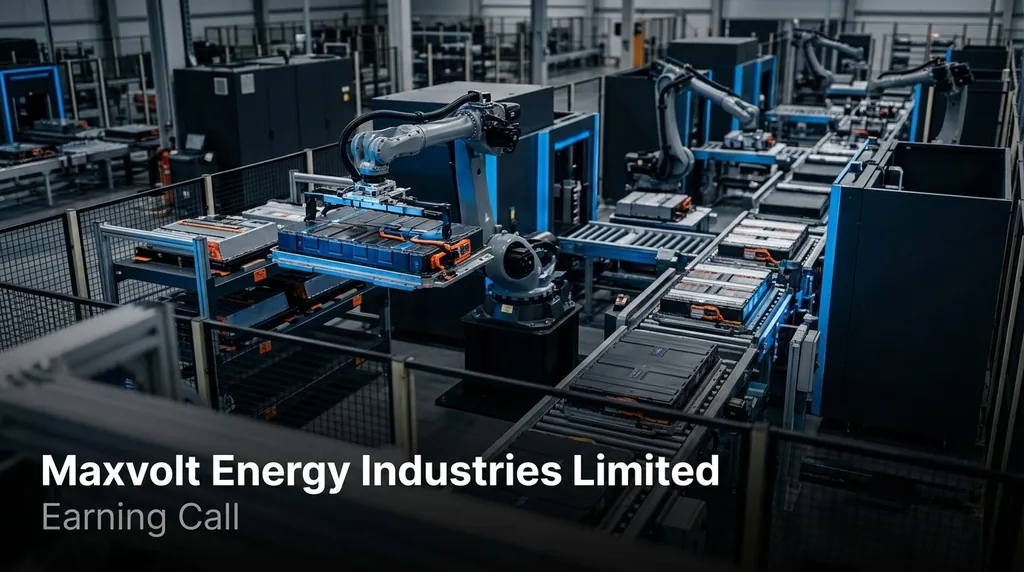
The leadership team expressed strong confidence in maintaining this growth momentum, targeting an expansion to 25,000 battery packs per month by August 2026. The company is actively moving toward a circular lithium ecosystem to mitigate raw material volatility and enhance resource efficiency. By 2032, Maxvolt aims to capture approximately 5% of the Indian lithium-ion market, translating to a projected revenue of ₹6,000 crore.
Future growth is expected to be supported by funding through debt from major financial institutions like SBI and ICICI, rather than immediate equity dilution, to preserve stakeholder value while financing capital expenditure.
Business Overview and Strategy
Founded in 2019, Maxvolt Energy has evolved from a small startup into a fast-growing energy solutions provider with a presence across 1,200 pin codes in India. The company focuses on customized Battery Management Systems (BMS) and design-led solutions for e-scooters and ESS applications. A key strategic pillar is its upcoming lithium recycling project.
Phase 1, focused on crushing and black mass generation, has seen land allotment from the UP MSME department and is slated for operation in FY27. Phase 2 will target metal extraction (lithium, cobalt, and nickel) by FY29, aiming for margins in the range of 30-35%.
Sector Dynamics
The domestic lithium-ion battery market is projected to grow from $3.2 billion in 2024 to $9.6 billion by 2033, representing a compound annual growth rate (CAGR) of 12%. Management noted that the recycling segment alone presents a $1.5 billion annual opportunity by 2030. Maxvolt is positioning itself to capitalize on these tailwinds, supported by government initiatives like FAME-II and state-level EV mandates.
Additionally, the company is preparing to enter export markets across Southeast Asia, the Middle East, and Africa, focusing initially on the ESS segment where global demand for sustainable power solutions is accelerating.
What to Watch
- Implementation and timeline of the second expansion phase to reach 25,000 battery packs per month by mid-2026
- Progress on the recycling facility construction scheduled to begin in March 2026
- Successful penetration into international markets including the Middle East and Africa
- Volatility in lithium prices and its subsequent impact on the inventory management strategy
- Shift in revenue mix as the Energy Storage Systems (ESS) segment scales relative to the e-scooter segment
Management Quote
Our long-term mission remains steadfast to build India's most trusted and sustainable lithium ecosystem, where every battery manufactured is efficiently used, repurposed, and recycled to recover valuable materials for the next generation.