What Is the Expansion?
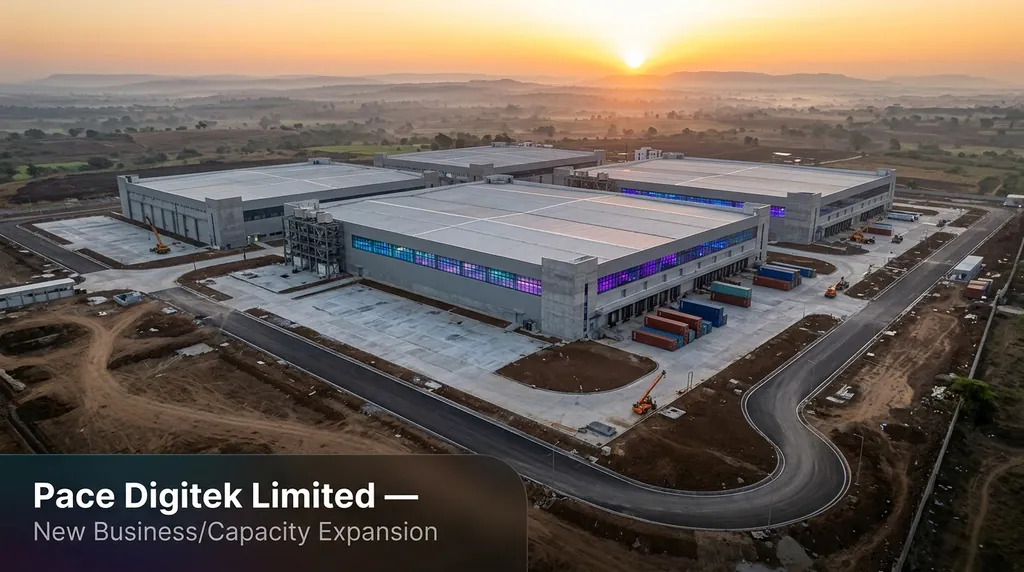
Pace Digitek’s material subsidiary, Lineage Power Private Limited, has operationalised a new 2.5 GWh manufacturing line, bringing the group’s total BESS capacity to 5 GWh. The facility focuses on advanced cell-to-pack and pack-to-container assembly, specifically designed for high-density utility-scale applications. Over the last twelve months, the company has successfully manufactured and delivered more than 300 utility-scale BESS containers, accounting for approximately 1.5 GWh of storage capacity.
This expansion is part of a phased scale-up strategy aimed at reaching 10 GWh of operational capacity to maintain a leading position in the domestic energy storage market.
Strategic Rationale
The capacity addition is strategically timed to service an executable order book of ₹11,338 crore. Recent contract wins highlight the demand, including a ₹4,945 million EPC order from NTPC for the Nabinagar Super Thermal Power Station and a ₹7,099 million contract from NLC India Renewables. These projects necessitate large-scale deployment of storage systems for grid balancing and renewable energy integration.
By doubling its internal manufacturing capacity, Pace Digitek aims to improve execution timelines, enhance operational flexibility, and reduce dependency on external supply chains for its turnkey EPC and power infrastructure projects.
Business Model
- Operates an integrated platform spanning manufacturing, engineering, and lifecycle maintenance
- Generates revenue through direct BESS hardware supply and turnkey EPC execution
- Provides long-term value through multi-year Operations and Maintenance (O&M) service contracts
- Focuses on backward integration including in-house container fabrication to improve margins
- Evaluating future transition into battery cell manufacturing to further control the value chain
- Serves two primary high-growth segments: Energy Storage and Telecom Infrastructure
Industry Outlook
India's battery energy storage market is entering an execution-intensive phase, with a total project pipeline estimated to exceed 92 GWh in 2026. Policy drivers such as the Energy Storage Obligation (ESO) and government viability gap funding are accelerating the adoption of storage to manage renewable energy intermittency. The sector is moving from tender-based proposals to large-scale commercial deployments, where BESS is now critical for grid stability and peak load management.
Projections suggest India will require approximately 321 GWh of cumulative storage capacity by 2035 to support its national target of 500 GW of renewable energy.