Production Commenced — What It Means
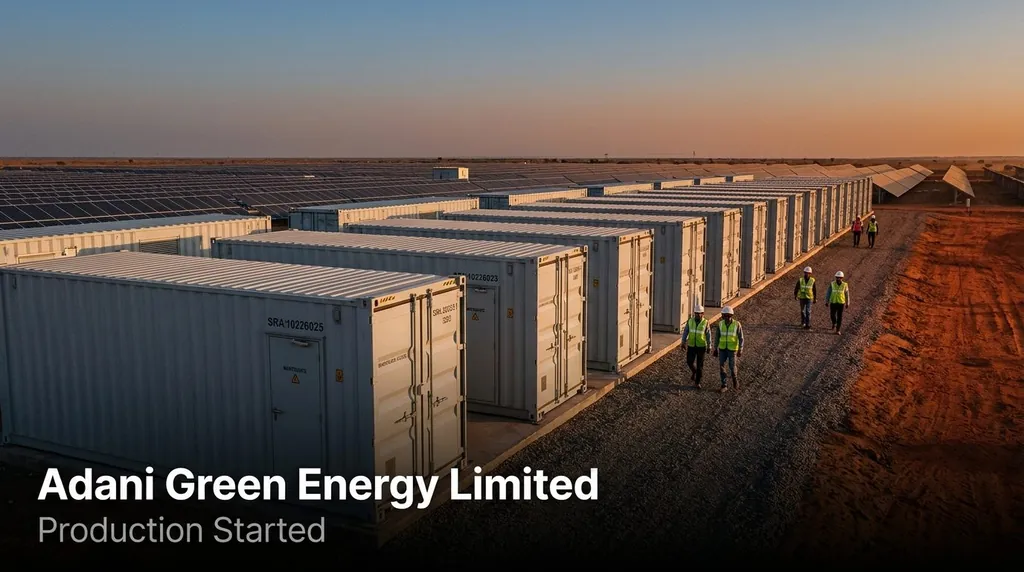
Adani Green Energy Limited has initiated commercial output for a massive 1,990 MWh Battery Energy Storage System (BESS) and a 50 MW solar project in Khavda, Gujarat. The BESS infrastructure is distributed among three specific subsidiaries: Adani Renewable Energy Thirty Six (642 MWh), Thirty Seven (1,042 MWh), and Forty Three (306 MWh). This strategic operationalisation follows clearances obtained on the evening of May 25, 2026.
The move establishes Khavda as a central hub for the company's hybrid renewable strategy, integrating energy generation with large-scale storage to manage grid intermittency.
Revenue Impact
The activation of these assets directly transitions heavy capital expenditure into steady cash flow. With the company already recording a quarterly net profit growth of 1068.29% sequentially, these new facilities are expected to provide further stability to the bottom line. The 1,990 MWh storage capacity is particularly valuable as it allows for energy arbitrage and grid stabilization services, which typically command higher margins than simple solar generation.
This commissioned capacity supports the company's high operating profit margin of 82.3%, ensuring that the capital intensive construction phase now yields commercial results.
Financial Context
- Trailing twelve-month operating revenue stands at ₹12,928 crore with an 11.25% annual growth rate
- Net profit for the latest quarter reached ₹397 crore, representing a 72.61% year-on-year increase
- Promoter holding remains substantial at 62.43%, while institutional investors hold a 15.66% stake
- The company maintains a Trendlyne Durability Score of 60, reflecting consistent financial health
- Market capitalization has reached ₹2,32,433 crore, positioning it as a leader in the green utility sector
Sector Tailwinds
The Indian renewable energy sector is increasingly focused on Battery Energy Storage Systems to achieve round-the-clock green power delivery. With the industry price-to-earnings ratio at 106.01, Adani Green's expansion into BESS aligns with national targets to integrate 500 GW of non-fossil capacity by 2030. High sector momentum is driven by supportive policy frameworks and the technical necessity for storage to prevent grid congestion.
Adani Green’s ability to commission nearly 2 GWh of storage in a single phase demonstrates execution capability in a sector where storage technology is the next major frontier for utility-scale providers.