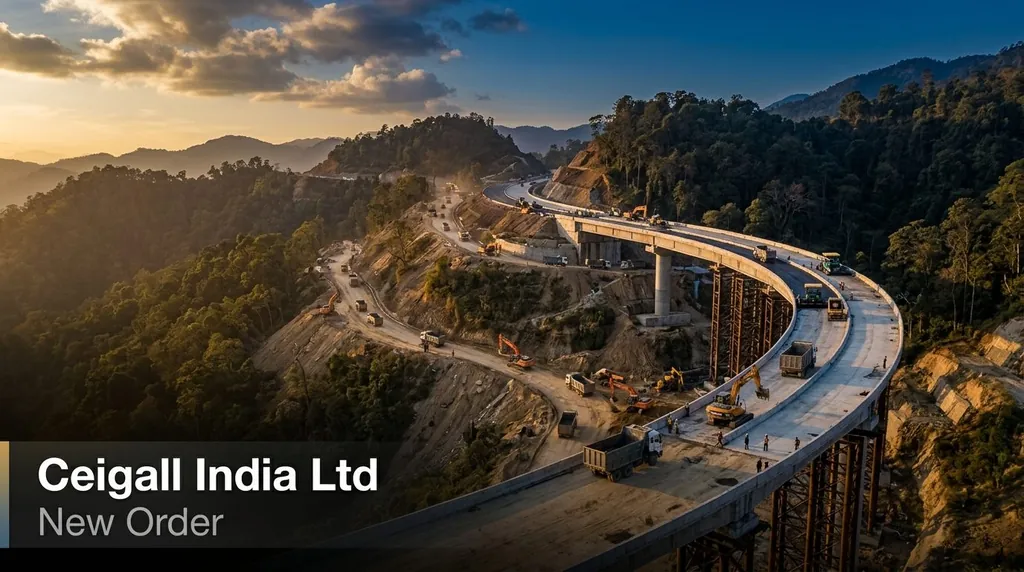
Project Scope and Strategic Details
The project involves the construction of a critical stretch from km 85.60 to km 168.00 on the Lada-Sarli section of the Frontier Highway (NH-913) in Arunachal Pradesh. Awarded by the Ministry of Road Transport and Highways, the contract follows an Engineering, Procurement, and Construction model. Ceigall India Limited operates as the lead partner in a joint venture with Sushee Infra & Mining Limited, maintaining a dominant 74% stake.
The timeline is set for a 48-month construction cycle followed by a five-year maintenance period, focusing on upgrading the road to an intermediate lane standard to improve regional connectivity.
Business Impact and Execution Strategy
Securing this ₹704.70 crore contract enhances the order book of Ceigall India, reflecting its competitive edge in large-scale government infrastructure tenders. By maintaining operational control via its 74% share in the joint venture, the company ensures a significant portion of the revenue and project oversight. This win aligns with the firm’s strategy of geographic diversification, establishing a footprint in the challenging terrain of Arunachal Pradesh.
The project provides revenue visibility for the next four years, supporting the company’s objective of sustaining the strong double-digit growth seen in its latest quarterly results.
Company Overview
- Ceigall India is an infrastructure company primarily engaged in the construction of highways, bridges, and flyovers
- The company has successfully executed complex projects including elevated corridors, tunnels, and railway overbridges
- The firm operates across several Indian states, leveraging an extensive fleet of specialized machinery and internal engineering
- Since its public listing, the company has focused on bidding for high-value government contracts in the road transport sector
- The organization maintains a lean structure that emphasizes timely project delivery and adherence to quality standards
Industry Context and Strategic Growth
The infrastructure sector in India is experiencing a significant tailwind driven by increased government spending on strategic border roads. The NH-913 Frontier Highway is a high-priority project designed to bolster connectivity in sensitive Himalayan regions. While the sector faces headwinds like fluctuating raw material costs and environmental challenges in hilly terrains, the Ministry’s preference for the EPC model helps mitigate developer risk.
Established players with proven execution capabilities in rugged topographies are increasingly favored for these complex projects, fostering a consolidated market environment where large, specialized firms dominate the bidding landscape.